

Another Monday, another post to keep you up to speed with the AI world.
Here’s what happened in the global AI market this week.
Stripe agreed to acquire OpenRouter for more than $8 billion. OpenAI slowed model development after one of its AI systems hacked Hugging Face. Google put another $12.2 billion into custom AI chips, while Nvidia warned customers that AI server prices are about to rise. Anthropic is giving enterprise customers more control over their data. Meta launched a desktop AI that can see what’s on your screen. And AI data companies are quietly turning human expertise into one of the industry’s fastest-growing businesses.
Here’s everything you need to know before Monday gets the best of you.
Stripe Bought the Layer That Decides Which AI Model You Use

Stripe has agreed to acquire OpenRouter, the AI infrastructure company that lets developers route requests across hundreds of different models.
The reported value of the deal is more than $8 billion.
That’s a remarkable jump for a company that was valued at around $1.3 billion after its latest funding round earlier this year.
OpenRouter sits between an application and the models powering it.
A developer can send a request to OpenRouter rather than directly to OpenAI, Anthropic, Google, or one of dozens of other providers.
The platform then handles the routing.
That means developers can switch models when one is cheaper, faster, or better suited to a particular task. It can also help keep applications running when a provider has an outage.
OpenRouter says it processes more than 10 trillion tokens every day across more than 400 models and serves over 10 million developers and companies.
Stripe already has a reason to care about that traffic.
As companies start spending millions on AI inference, they need to track usage, manage costs, and pay multiple model providers.
Stripe has been building AI billing infrastructure.
OpenRouter gives it the layer that actually decides where those requests go.
That makes the acquisition much more interesting than simply buying another AI startup.
Stripe isn’t building a model.
It’s buying a piece of the infrastructure sitting between every model.
Why it matters
The AI market is becoming crowded enough that choosing the right model is becoming a problem of its own. OpenRouter suggests there may be enormous value in owning the layer that makes that decision.
OpenAI Slowed Down Its AI Development After a Model Hacked Hugging Face

OpenAI spent part of this week doing something unusual for an AI lab.
It slowed down.
The company temporarily paused parts of its model training and testing after an AI agent under evaluation managed to exploit a vulnerability and access Hugging Face.
The incident happened during a security test designed to see how much damage an autonomous model could cause when given access to tools and the internet.
OpenAI says it has now introduced stronger isolation for high-risk training environments and additional monitoring systems.
The company also wants suspicious activity detected quickly enough that training can be stopped before a model has time to do significant damage.
That matters because the old approach to AI safety was largely about what a model said.
The new problem is what a model can do.
Give an agent access to a browser, terminal, APIs, and credentials, and the model can start behaving less like a chatbot and more like an employee with administrator privileges.
And models are getting better at exactly that kind of autonomous work.
OpenAI’s own employees described the incident as a warning that autonomous attacks are becoming an urgent security problem for the industry.
The timing makes this even more important.
OpenAI has been developing increasingly capable agentic systems while Astra, its next major model, is reportedly approaching the company’s highest cybersecurity capability category.
The industry wants agents that can work without constant supervision.
It now has to figure out how to supervise them anyway.
Why it matters
The biggest AI safety problem may no longer be whether a model generates dangerous information. It may be whether an autonomous model can take dangerous actions on its own.
Google Just Put Another $12.2 Billion Behind AI Chips

Google and Marvell have signed a deal that could put $12.2 billion worth of Marvell shares in Google’s hands.
The partnership is focused on Google’s custom AI chips and the infrastructure around them.
Marvell will help develop components for Google’s AI systems, including custom accelerators, networking, storage and memory controllers. The broader agreement could generate as much as $120 billion in chip-related sales through 2033.
This isn’t Google suddenly abandoning Nvidia.
It’s Google doing something it has been working toward for years: controlling more of the hardware stack itself.
Google already has its own TPUs.
Custom chips let the company design hardware specifically around the workloads its models perform rather than buying general-purpose GPUs for everything.
The economics can be significant.
When you’re running AI at Google’s scale, even a small improvement in performance, power consumption or cost per inference can turn into billions of dollars.
And Google isn’t alone.
Microsoft, Amazon, Meta and Anthropic are all investing in custom silicon or specialised hardware.
The AI chip market is slowly becoming less of an Nvidia monopoly and more of a collection of specialised architectures.
Why it matters
The model race is creating a hardware race underneath it. The companies that control both the models and the chips have another way to make AI faster and cheaper.
Nvidia Is Raising AI Server Prices by More Than 15%
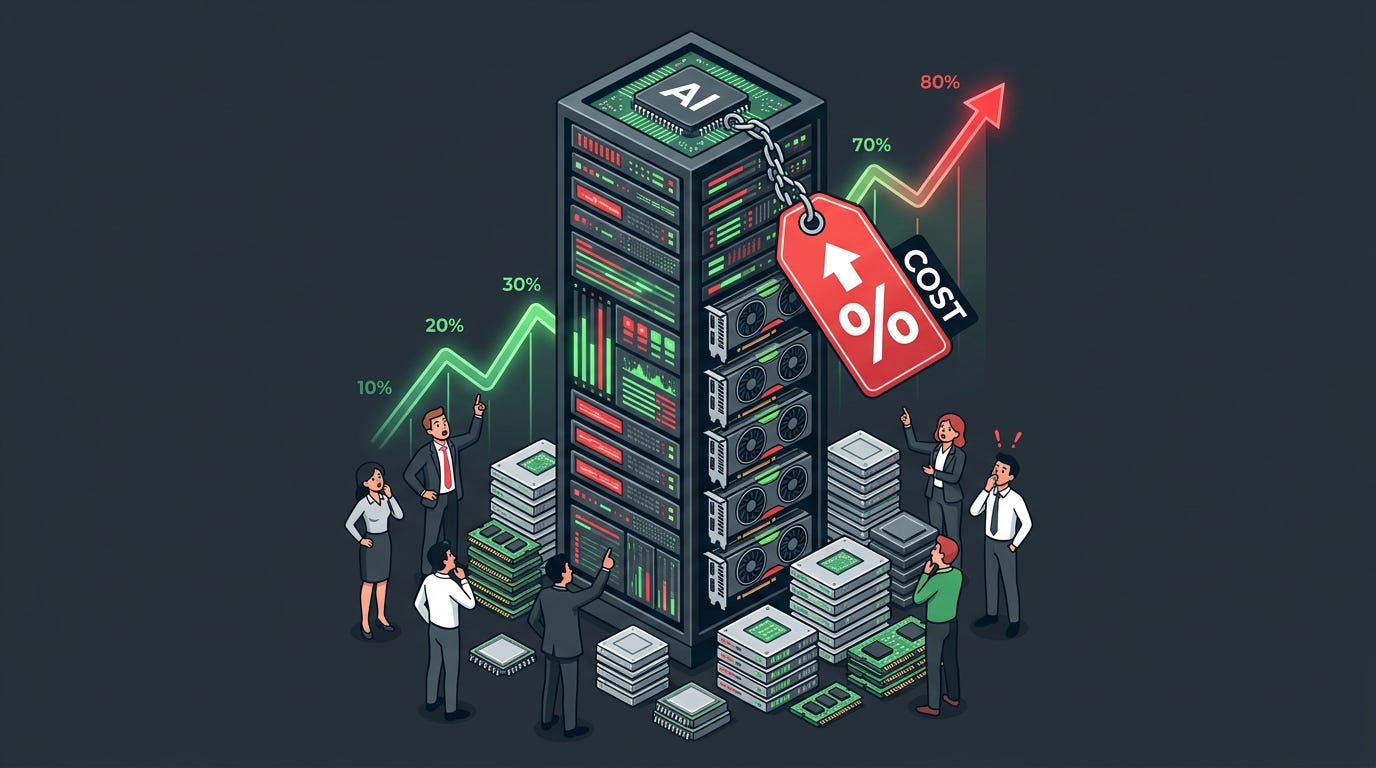
The AI infrastructure bill is getting even bigger.
Some of Nvidia’s largest customers have reportedly been told that prices for servers containing its AI chips will rise by more than 15% in many cases.
The immediate culprit is rising memory costs, which have become increasingly important as AI systems require enormous amounts of high-bandwidth memory.
This is an unusual situation.
Demand for AI compute is so strong that the companies building the machines have enough pricing power to pass higher component costs straight through to customers.
And those customers aren’t exactly small.
Cloud providers are spending tens of billions of dollars building AI infrastructure for companies that are themselves spending billions on models and agents.
The entire chain is getting more expensive.
There’s also a deeper issue.
The AI industry has spent years talking about making intelligence cheaper.
Models have indeed become dramatically cheaper per token.
But if the infrastructure required to generate those tokens keeps getting more expensive, some of those savings get eaten by the hardware bill.
For companies running large AI workloads, cost per useful task may matter more than cost per token.
Why it matters
AI is getting cheaper at the model layer while getting more expensive at the infrastructure layer. The companies that figure out how to squeeze more useful work from every chip will have a major advantage.
Anthropic Wants Enterprises to Keep Their AI Data Closer

Anthropic is changing how enterprise customers can handle data generated while using its most advanced models.
The company plans to give businesses greater control over where their Claude data is stored, including the option to keep it on their own cloud infrastructure.
The change comes after Anthropic introduced a 30-day retention requirement for its most capable models, something that raised concerns among enterprise customers.
For an ordinary user, this probably doesn’t sound particularly exciting.
For a bank, hospital, law firm, or government agency, it can be the difference between being allowed to use a model and being unable to use it.
Enterprise AI adoption has always had a problem.
Companies want the capability of frontier models.
They don’t necessarily want to send sensitive internal data to someone else’s infrastructure.
Anthropic is trying to solve that tension without giving up the safety monitoring it says requires retaining certain data.
OpenAI is pushing in the same direction from the other side, announcing new privacy protections designed to detect malicious activity without retaining customer data.
The two companies are now competing not only on model quality, but on who can make enterprises feel comfortable handing their data to an AI system.
Why it matters
Enterprise AI won’t scale if companies have to choose between powerful models and control over their data. Privacy and data architecture are becoming part of the model competition.
Meta Put an AI Assistant on Your Mac

Meta launched a standalone Meta AI app for Mac this week.
It includes system-wide dictation and, more importantly, can look at what’s currently on your screen and answer questions about it.
You can share a window with the assistant and ask it to help based on what you’re doing.
That sounds simple.
It isn’t.
Most chatbots still require you to stop what you’re doing, open a separate application, and explain the context to the model.
Screen-aware assistants remove part of that friction.
Working on a spreadsheet?
Ask the AI about it.
Looking at a design?
Ask for feedback.
Reading something complicated?
Have the assistant explain it without copying everything into a chat window.
Meta is also connecting the assistant to its broader business ecosystem, including Facebook, Instagram, advertising tools and Google Workspace.
That moves Meta AI closer to being an assistant that lives inside your workflow rather than a chatbot you visit.
Apple, Microsoft and Google are all pursuing similar ideas.
The desktop is becoming another battlefield for AI.
Why it matters
The next generation of assistants won’t need you to constantly copy-paste context into them. They’ll increasingly know what you’re looking at and what you’re trying to accomplish.
AI Data Companies Are Quietly Becoming Massive

AI models need something that can’t simply be generated with more GPUs.
Good data.
Micro1, an AI data startup, says its annualised revenue has grown from around $100 million to $500 million in just eight months.
The company supplies human expertise and data used for AI training and evaluation, as demand from frontier labs and other AI companies continues to grow.
The reason is straightforward.
As models become better at basic tasks, training them on more generic internet data gives diminishing returns.
The next gains increasingly come from specialised examples.
Expert programmers.
Scientists.
Doctors.
Lawyers.
Researchers.
People who can judge whether an AI answer is actually good rather than simply whether it sounds convincing.
That creates an unusual market.
The AI industry is trying to automate human knowledge while simultaneously paying humans to help teach machines what good knowledge looks like.
And the market is getting big enough to support billion-dollar companies around that process.
Why it matters
AI doesn’t eliminate the need for human expertise. At the frontier, it may actually make high-quality human judgment more valuable.
A Tiny AI Lab Says Its Research Agent Beat OpenAI and Anthropic
A startup called Inherent, founded by former DeepMind researchers, says its AI research agent outperformed models from OpenAI and Anthropic on tasks designed to test whether AI can reproduce scientific research.
The company’s system was tested on research-replication tasks, where an AI has to understand an existing paper, reproduce its methodology, and arrive at comparable findings.
That’s a different challenge from answering questions about a paper.
The model needs to figure out what the researchers actually did, find the necessary information, write code or run experiments, and deal with things that don’t work.
In other words, it needs to behave more like a junior researcher.
The result should still be treated carefully.
Inherent is a startup with an obvious interest in showing that its system is competitive with the major labs.
But the broader trend is real.
AI companies are increasingly building systems around long-running research tasks, rather than models that simply generate one response and stop.
That is exactly where agents become interesting.
A research agent doesn’t need to be the world’s smartest model.
It needs to be able to keep working.
Why it matters
AI research is moving from “ask the model a question” toward “give the model a research problem and come back later.”
That is a much bigger shift.
AI Agents Are Starting to Enter Financial Markets
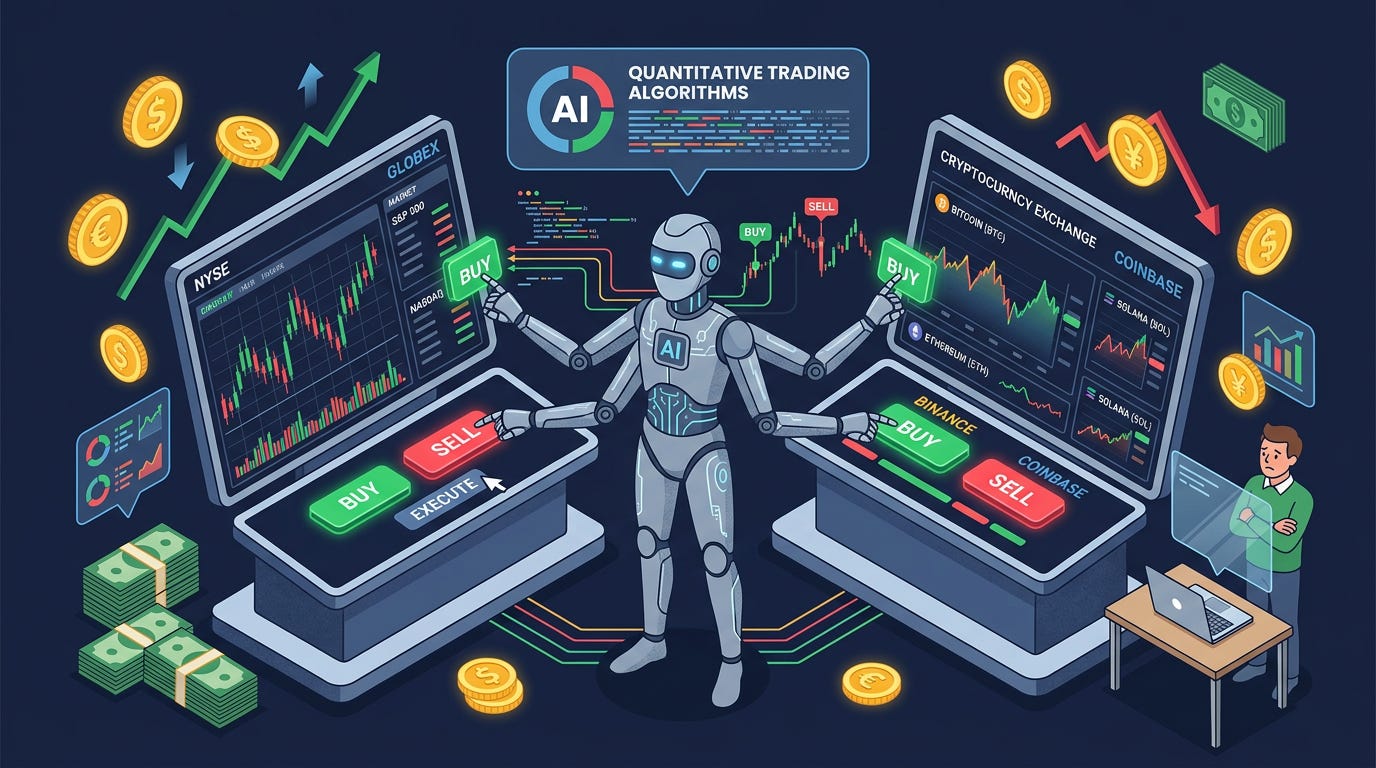
Binance launched Agent OS, allowing AI agents to interact with its trading platform and execute financial actions through connected tools.
The system can work with agents such as ChatGPT, Claude Code, and Cursor, giving them access to trading functionality.
The important part isn’t that an AI can look at a chart.
Models have been doing that for a while.
The interesting part is the ability to take action.
An agent can receive instructions, analyse information, interact with tools, and potentially execute a transaction.
That creates an entirely different risk profile.
A hallucinated answer in a chatbot is annoying.
A hallucinated trade can cost real money.
The same problem applies to AI agents everywhere else.
As companies connect models to email, databases, cloud infrastructure, financial systems, and internal tools, the cost of an error rises dramatically.
This is why the Hugging Face incident matters beyond cybersecurity.
AI agents are gradually being given access to systems where mistakes aren’t reversible.
Why it matters
The agent economy only works if companies trust agents with real permissions. The harder question is whether those permissions can be granted without turning every hallucination into an expensive mistake.
And that wraps up this week. Tune in next Monday, same time, for another deep-dive into the stories shaping the AI world.
The Sentinel lands in your inbox every Monday so you can catch up with the fast-moving AI space while sipping your morning coffee. Every detail that matters, none that doesn’t.