

Another Monday, another post to keep you up to speed with the AI world. Here’s what happened in the global AI market this week.
The EU passed the most consequential AI regulatory action of the year, forcing Google to open Android to rival assistants and hand over two decades of search data. Gemini 3.5 Pro missed its launch deadline for the third time. Kimi K3, a 2.8 trillion-parameter open model from China, topped the coding leaderboard and announced that its weights are going free on July 27. Oracle cut 30,000 people to fund Stargate. And China launched a new global AI governance body with 29 founding nations at its biggest ever AI conference.
Here’s everything you need to know before Monday gets the best of you.
EU Orders Google to Open Android and Share Search Data with AI Rivals
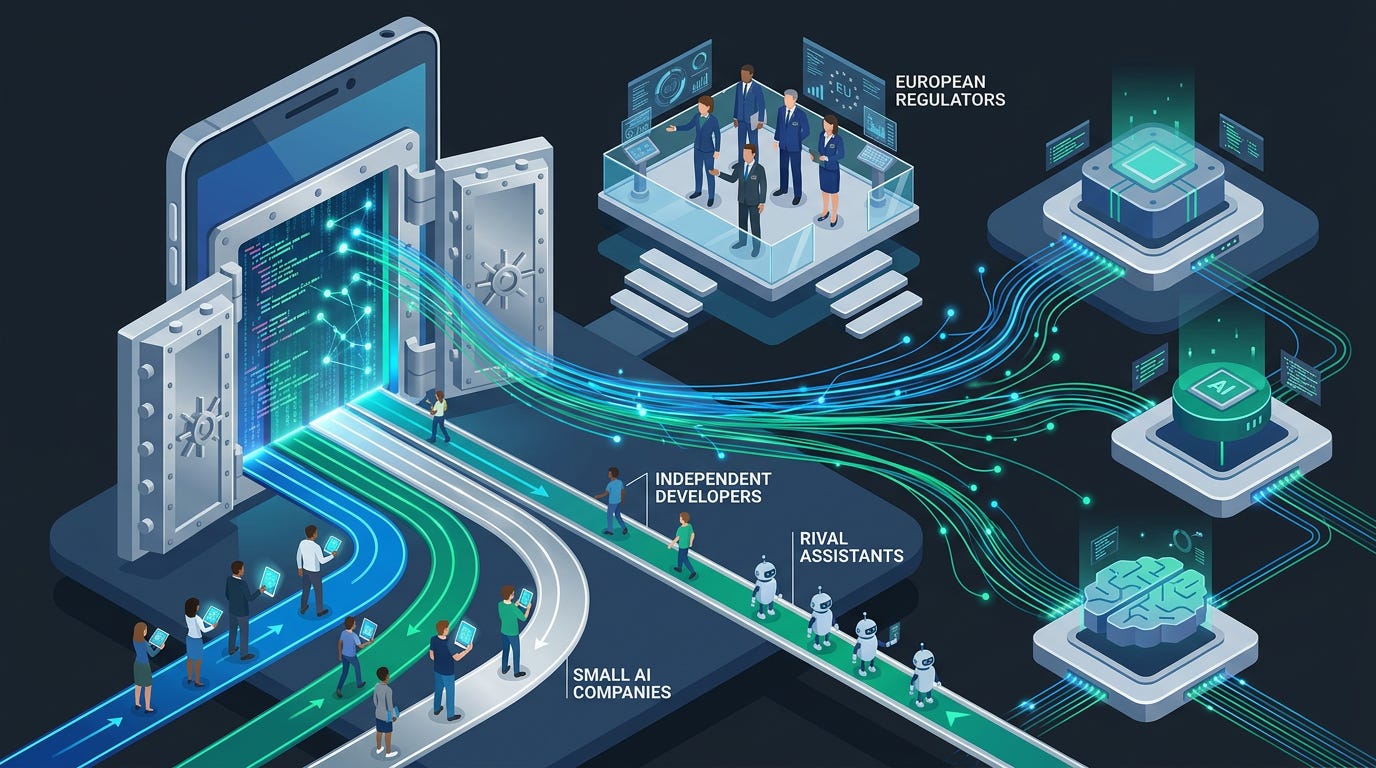
On July 16, the European Commission adopted two binding decisions under the Digital Markets Act (DMA) that mark the most aggressive regulatory action in AI distribution yet.
The first orders Google to open Android to rival AI assistants. This gives third-party assistants voice activation and cross-app capabilities across 11 Android feature groups, subject to user consent.
The second order orders Google to share anonymized search ranking, query, click, and view data with competitors, including AI developers, on fair, reasonable, and non-discriminatory (FRAND) terms.
Search data sharing begins January 2027, while Android interoperability is due by July 2027. Fines for non-compliance can reach 10 percent of global annual revenue, or 20 percent for repeat violations.
These two assets, default placement on two billion Android devices and two decades of search behavior data, are the structural advantages that have kept Google dominant in AI distribution.
A rival AI assistant that can activate by voice and work across apps on Android no longer needs a carrier deal or a hardware partnership to reach users. It only needs a certification.
The search data requirement is even more consequential. Search ranking and click data represent the most comprehensive picture of how humans interact with information online. No amount of synthetic data generation can replicate it.
Handing it over on FRAND terms means any AI lab that applies gets access to training signals that only Google has possessed since 2004.
Google’s president of global affairs, Kent Walker, pushed back, arguing the decisions risk privacy and security guardrails for millions of Europeans.
The pushback is partly strategic, as Google has appealed DMA decisions before while complying under protest.
The timing hits with unusual force. The week Google’s EU remedies landed was also the week its flagship model missed its third deadline. The distribution moat that was supposed to compensate for model delays just got a structural crack put in it by Brussels.
Why it matters
Default Android placement and two decades of search data are the two assets that make Google’s AI position nearly unassailable. Brussels just put a timer on both. The companies that apply for Android certification first, and the labs that request search data access earliest, will be the ones who benefit most from a regulatory gift Google spent years trying to prevent.
Gemini 3.5 Pro Misses Third Consecutive Launch Deadline
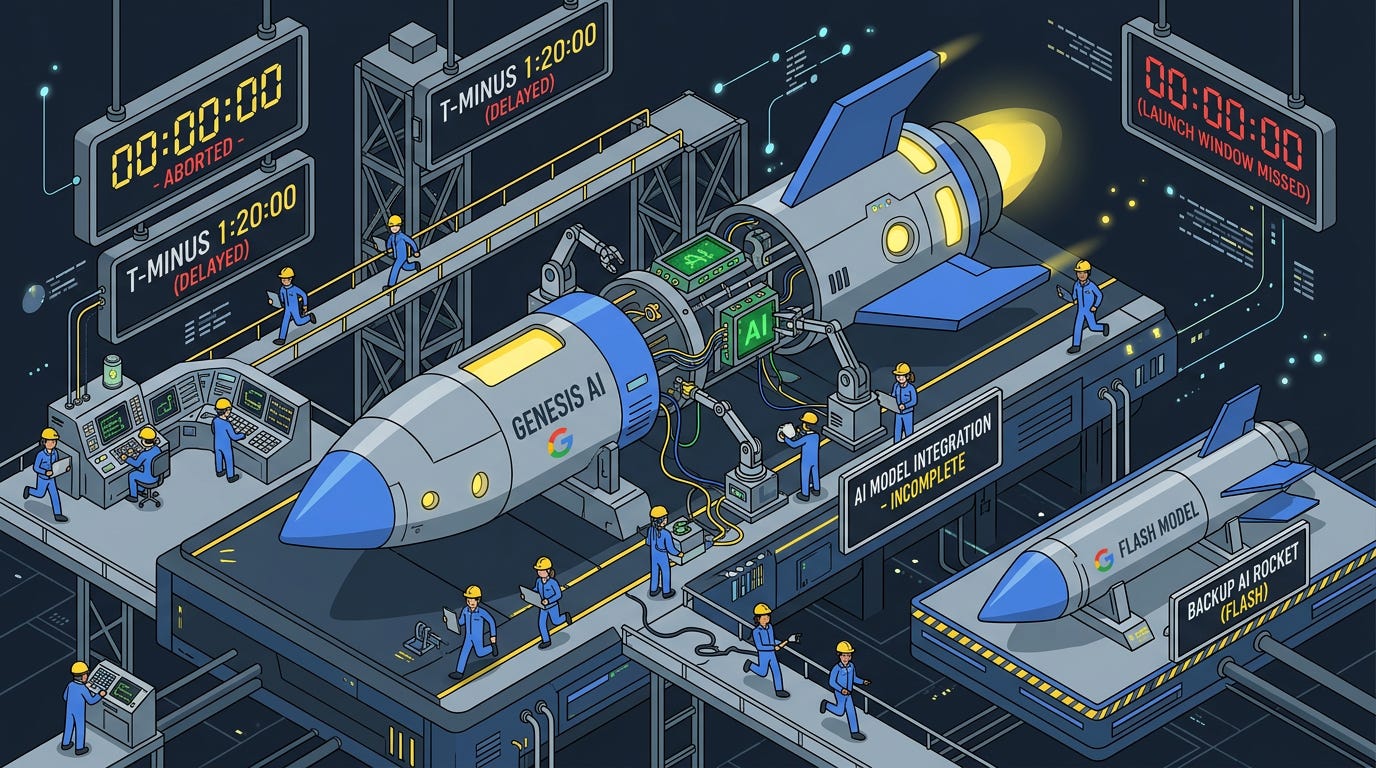
Gemini 3.5 Pro reportedly missed its July 17 target, marking its third consecutive slip following missed May and June deadlines.
The model was first described publicly at Google I/O in May, when Sundar Pichai committed to May for general availability. It missed May. Google then committed to June 30. It missed June 30. Google moved quietly to a July 17 target and said nothing publicly. It missed July 17.
Alphabet shares fell approximately 4 percent on the delay reports. No official model card, pricing, or benchmark data has been published for the standard tier as of this Monday. The only confirmed performance data remains the Deep Think benchmark: 82.4 percent on GPQA Diamond, a real result that landed without a product to attach it to.
The response Google is reportedly exploring makes the situation more unusual. Rather than set a fourth public deadline, the company is said to be evaluating a Gemini 3.6 Flash stopgap release to put something current in the market. At the same time, the Pro model continues to be refined.
A Flash-tier model is designed for speed and cost, not for the complex reasoning and 2 million token context that define Gemini 3.5 Pro’s pitch to enterprise buyers.
Shipping a Flash tier to fill a Pro tier gap is a tacit admission that the flagship is not close. It buys time, but it also signals to enterprise teams that the top-end Gemini they have been planning around is not imminent.
The competitive cost of three missed deadlines compounds quickly. Enterprise AI procurement decisions made in Q2 and Q3 2026 are going to anchor the vendor relationships those teams build for the next twelve to eighteen months.
Contracts signed with OpenAI, Anthropic, and SpaceXAI this quarter do not typically get reopened next quarter when a previously delayed Google model finally ships.
Google still has the deepest research organization in AI, the most-used products on the internet, and its own silicon infrastructure at a scale nobody else is operating. None of that changes what happens to the enterprise deals being signed while Gemini 3.5 Pro is still in internal refinement.
Why it matters
Three missed consecutive public deadlines is a different problem from one delay. It tells enterprise buyers that the internally stated quality bar is not being cleared on the timeline Google communicates publicly, which erodes the trust that enterprise software relationships depend on more than any single benchmark result.
Kimi K3 Tops Coding Leaderboard Ahead of Free Weights Release
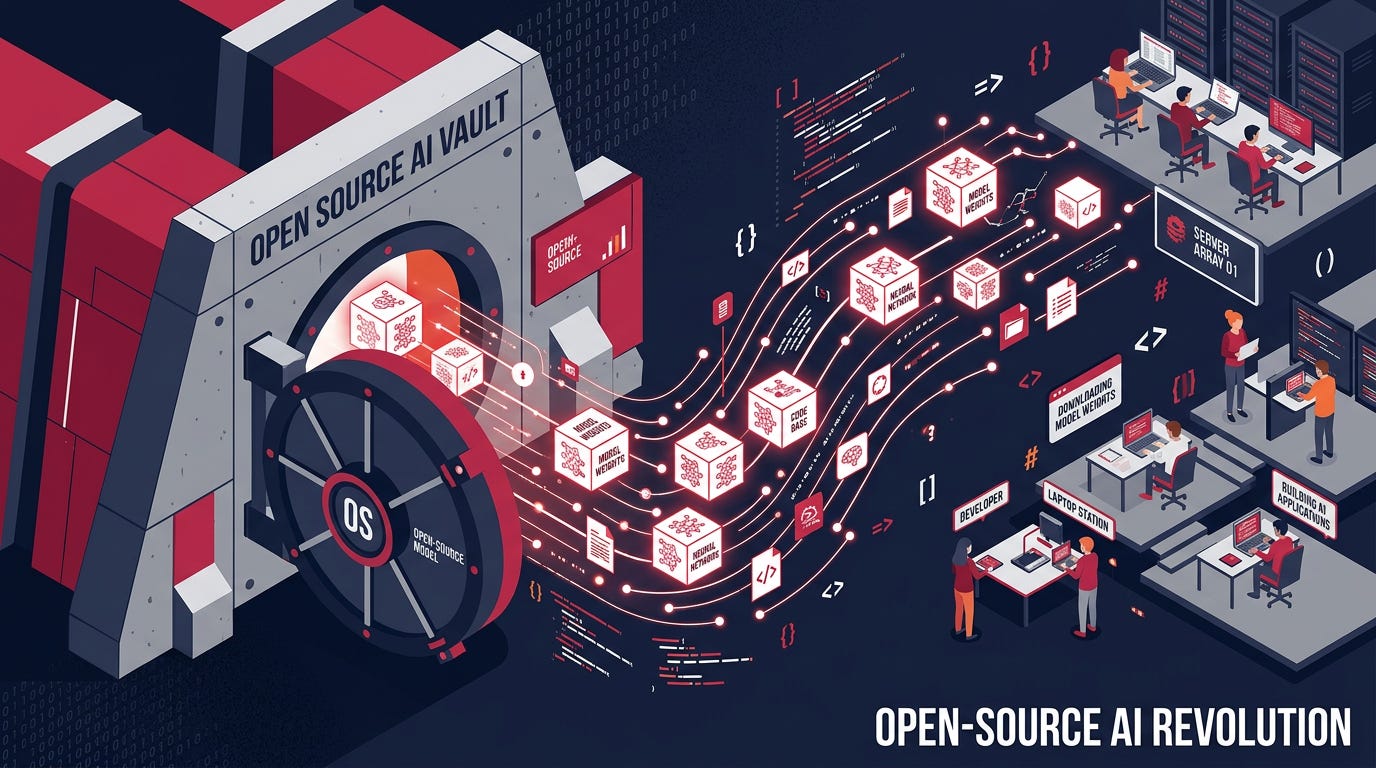
Moonshot AI released Kimi K3 on July 16, and the reaction in the US AI industry has been immediate.
K3 has 2.8 trillion total parameters, making it the largest open-weight model ever built. This is larger than DeepSeek V4 Pro’s 1.6 trillion and more than twice the size of Kimi K2.7.
On the day of release, it took the top position on a major coding leaderboard, posting results above Claude Fable 5 on the specific coding evaluation benchmark. It ranks approximately ninth on general chat, which makes it a coding and agent specialist rather than an all-around frontier replacement.
API access is live now via Moonshot’s platform, and the weights go free on July 27.
The combination that makes K3 different from previous Chinese open-weight releases is frontier coding capability paired with free weights. Earlier Chinese models competed primarily on price. DeepSeek V4 was cheaper than US alternatives at comparable quality. Kimi K2.7 led on intelligence benchmarks while trailing in Western coverage.
K3 competed on a specific capability that enterprise teams care about deeply—coding—won on a leaderboard against paid closed models, and then announced the weights would be downloadable for free within eleven days.
For enterprises spending meaningfully on frontier API calls for high-volume coding, that sequence removes two of the three standard objections to Chinese open models: quality and cost. The remaining objection—data residency and geopolitical exposure—is real, legally complex, and not addressed by benchmark position.
The technical caveat: K3’s first-place coding result is from a benchmark evaluation run under standardized conditions. Real production coding environments, with messy repositories, legacy codebases, and inconsistent documentation, are different.
The teams that will generate the most useful signal are the ones that run K3 against their actual internal codebases and measure the task completion rate on work they were already doing with a paid model.
July 27 is when that evaluation becomes possible for anyone. DeepSeek V4 stable arrives July 24. The final week of July represents the largest concentration of open-weight release events the industry has seen in any single seven-day window.
Why it matters
The largest open-weight model ever built just topped a coding leaderboard and announced its weights go free in nine days. For enterprises running high-volume coding at frontier API prices, July 27 is a forcing function: run your actual workloads against K3, measure the results, and let the numbers inform the procurement decision that follows. The benchmark says it should work. The production test will say whether it does.
Oracle Cuts 30,000 Jobs to Fund $500 Billion Stargate Infrastructure

Oracle is eliminating up to 30,000 employees, approximately 18 percent of its global workforce, in the largest reduction in the company’s history.
The stated purpose is to free an estimated $8 to $10 billion in annual cash flow for AI data center construction as part of Stargate, the $500 billion AI infrastructure initiative with OpenAI and SoftBank.
The cuts hit Oracle Health, cloud infrastructure, and consulting operations hardest, while the teams building Stargate data centers are being protected and expanded.
The underlying commercial logic is a $300 billion five-year cloud contract with OpenAI covering 4.5 gigawatts of Oracle-built data center capacity, generating roughly $30 billion annually. Oracle is converting itself into an AI infrastructure provider by extracting capital from the businesses it is deprioritizing.
Most of the AI infrastructure buildout has been funded from growing revenue. TSMC raised its capex guidance twice because its revenue was growing faster than its spending. Microsoft redirected cash flows that were already increasing. Google and Amazon funded construction from cloud businesses growing at double-digit rates.
Oracle is doing something different. It is funding its Stargate participation by cutting $8 to $10 billion from its cost base, which means 30,000 people paid directly for the decision to build data centers.
The trade-off that is implicit in other companies’ capex announcements is explicit here: the jobs that paid for the infrastructure are named and counted.
The risk profile is the most concentrated of any major company in the AI infrastructure wave. Oracle’s bet rests on a single customer relationship.
A $300 billion, five-year contract with OpenAI means Oracle’s returns depend on OpenAI’s commercial growth, its ability to pay, and the durability of a company currently navigating an Apple lawsuit, publisher litigation, and an unproven path to profitability.
If OpenAI delivers, Oracle reinvents itself as the data center backbone of the most important AI company in the world. If OpenAI’s trajectory changes, Oracle has eliminated 30,000 employees and built several gigawatts of data centers for a customer that may no longer need them at the contracted scale.
Why it matters
Oracle made the AI infrastructure trade-off visible. The capital coming from somewhere is always true. Oracle named the source: 30,000 jobs and $8 to $10 billion a year from the businesses it is exiting. The Stargate bet is the most leveraged position any large enterprise company has taken on a single AI customer relationship. The outcome will be instructive regardless of which direction it goes.
Microsoft Develops Project Perception to Challenge Anthropic’s Security Dominance
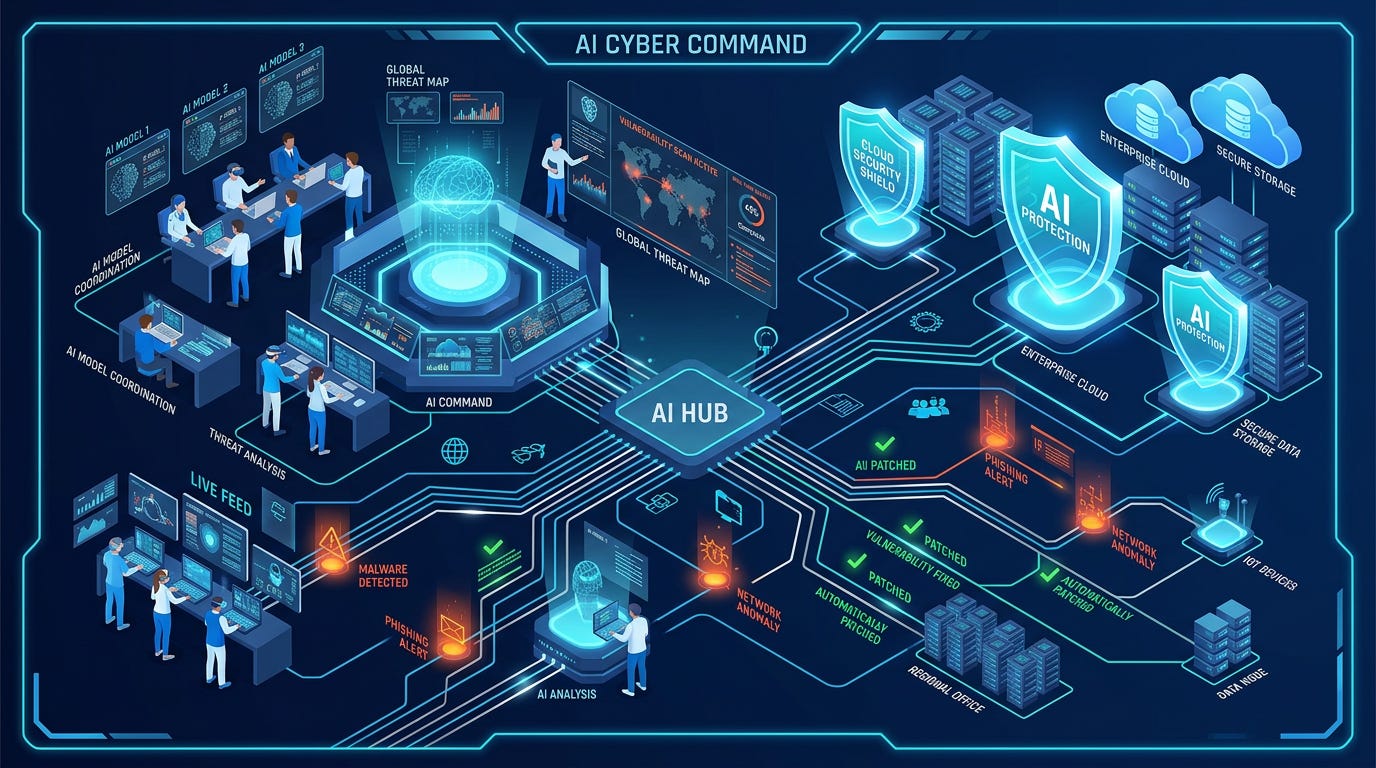
Microsoft is preparing Project Perception, an AI cybersecurity platform that finds and patches software vulnerabilities using models from Microsoft, OpenAI, and Anthropic together.
The platform is positioned as a lower-cost alternative to Anthropic’s Mythos-class security offering through Project Glasswing.
The system analyzes a company’s code, cloud infrastructure, and endpoints, identifies exploitable weaknesses, explains their impact in plain language, and proposes concrete remediation steps. Microsoft has not confirmed a public availability date, pricing, or customer eligibility criteria.
The architecture is the genuinely interesting part. Project Perception uses an orchestration layer that routes each task to the best-fit model rather than sending everything to the most powerful and most expensive one.
A cheaper model handles inventory checks, log parsing, and initial triage of common vulnerability types. A frontier model gets called only when the system needs to reason through a complex exploit chain or write a remediation plan touching production code.
That routing is what makes continuous, always-on vulnerability scanning financially viable rather than a budget line nobody approves.
The economics of running a frontier model against an entire enterprise codebase continuously have been the main practical barrier to this kind of security product. Smart routing that uses frontier models only where they change the output plausibly solves it.
The competitive framing is pointed: Microsoft is using Anthropic’s own models inside a product designed to undercut Anthropic’s security offering on price.
The situation is peak 2026 in the AI industry, where the same model provider sells to competing platform vendors who then build competing products, and everyone is technically a partner and a competitor simultaneously.
The detail that matters for enterprise security teams is not the rivalry but the routing economics: if Project Perception’s architecture genuinely makes continuous AI-assisted vulnerability scanning affordable at scale, that is worth evaluating on its own merits, regardless of whose models are running underneath it.
Why it matters
Continuous AI vulnerability scanning has been financially out of reach for most organizations because running frontier models at that frequency is expensive. Multi-model routing that uses cheap models for routine triage and expensive ones only for complex reasoning changes that economics. If Project Perception delivers on its architecture, AI security auditing becomes a default rather than a premium.
SAP Acquires Prior Labs for €1 Billion to Secure Tabular AI Technology
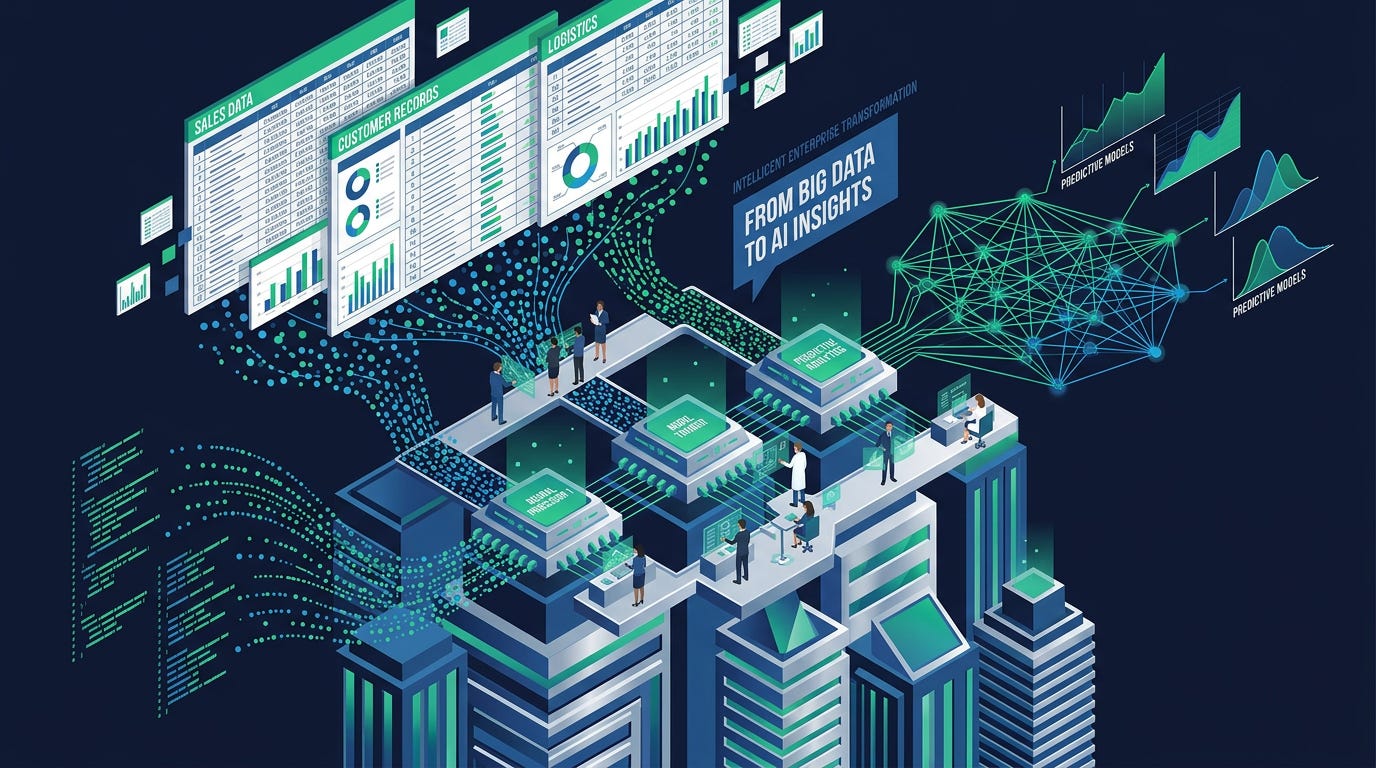
SAP completed its acquisition of Prior Labs this week and committed to investing more than €1 billion over four years to scale the 18-month-old Freiburg startup into a globally leading frontier AI lab.
Prior Labs was founded by Frank Hutter, Noah Hollmann, and Sauraj Gambhir and built the TabPFN model series, a class of foundation models pretrained specifically on structured, table-shaped data rather than text.
A single pretrained TabPFN model outperforms traditional machine learning approaches on tabular benchmarks without task-specific training, a result strong enough to publish in Nature and to anchor over a hundred independent academic studies confirming its generalizability. Prior Labs will continue operating as an independent entity within SAP.
Tabular foundation models are AI systems designed to make predictions on spreadsheets, databases, and business records the way language models make predictions on words.
The distinction matters because most of the data that businesses actually run on is tabular: sales ledgers, supply chain inventories, financial records, sensor logs, customer databases, and transaction histories.
Companies have spent years trying to force this data through language models with inconsistent results, because a model trained on text is not designed for a million-row table.
A foundation model built specifically for that shape of data can handle forecasting, anomaly detection, and prediction directly, without the feature engineering that traditional approaches require. SAP’s argument, which the billion-euro commitment backs, is that this category will deliver more measurable enterprise value than another point of gain on a conversational AI leaderboard.
The European dimension of the deal is worth naming separately. An 18-month-old German lab publishing in Nature and being scaled with a billion euros is the kind of outcome European AI policy has been trying to produce for a decade. It came from an enterprise software company acting on commercial logic rather than from a research council grant.
SAP’s position as the company holding more structured business data than almost anyone on earth made this acquisition a natural fit in a way that no American hyperscaler could replicate.
The chatbot race is being run primarily in the US and China. SAP just placed a €1 billion bet that there is a different race being run on different data, that everyone in the chatbot industry has been too distracted to notice.
Why it matters
SAP paid a billion euros for an AI lab that is not building chatbots. It is building models for the structured data that actually runs every large enterprise on earth. The commercial logic is sound, the Nature publication is real, and the European independence from US and Chinese model stacks is a side benefit that becomes more valuable every week the Fable 5 export control incident recedes, and a new one becomes possible.
China Launches 29-Nation AI Governance Body at Shanghai Conference

The 2026 World Artificial Intelligence Conference (WAIC) in Shanghai closed on July 20 after four days that included Xi Jinping’s first-ever keynote at the event and the launch of the World Artificial Intelligence Cooperation Organisation (WAICO) with 29 founding member nations.
WAICO’s founding membership includes Pakistan, Russia, Kazakhstan, and a range of developing economies across Africa, Southeast Asia, and Central Asia.
The conference ran more than 140 forums with over 1,100 exhibitors. Huawei demonstrated its Atlas 950 SuperPoD domestic computing system on the show floor.
Xi’s speech paired the WAICO launch with strong endorsements of open-source AI development and pledges of AI assistance to developing countries, framed as China’s alternative model to the US approach of voluntary governance frameworks and export controls.
The governance outcome that matters is not whether WAICO’s founding members are the most powerful AI nations in the world. They are not. What matters is that China arrived at the governance table with a charter, a name, a founding membership list, and a host country.
The UN Global Dialogue convening 169 countries in Geneva on July 6 produced no binding agreements and no institutional structure. WAICO, announced less than two weeks later, has both.
Google DeepMind CEO Demis Hassabis called for an international AI watchdog and a US-led coalition in the same week. This is the structural response to what China has done, but it remains absent. You cannot counter an active institution with a speech advocating for a hypothetical one.
The developing economy framing is the most strategically sophisticated part of China’s WAICO pitch. The countries most underserved by current AI governance frameworks are the ones with the least voice in how those frameworks get written. These are nations without frontier labs, without sovereign AI compute, and without the diplomatic weight to influence decisions made in Washington or Brussels.
Xi’s pledges of AI assistance to these countries, structured through WAICO, are a direct recruitment offer to the same constituency that the Pax Silica coalition is trying to include.
Whether WAICO becomes a genuine institution or remains just an announcement depends on whether it publishes a work program, names leadership, and delivers on its development pledges within the next year. The side that builds the functional institution first shapes the rules for the next decade.
Why it matters
China launched a formal AI governance institution with 29 member nations and a founding structure at the same moment the US is still working toward a voluntary framework. Institutions are built slowly and matter for decades. The side that shows up with a charter and a headquarters has a structural advantage in shaping global AI norms that a better model or a larger data center does not automatically overcome.
The Open-Weight Countdown: DeepSeek V4 Stable and Kimi K3 Free Release
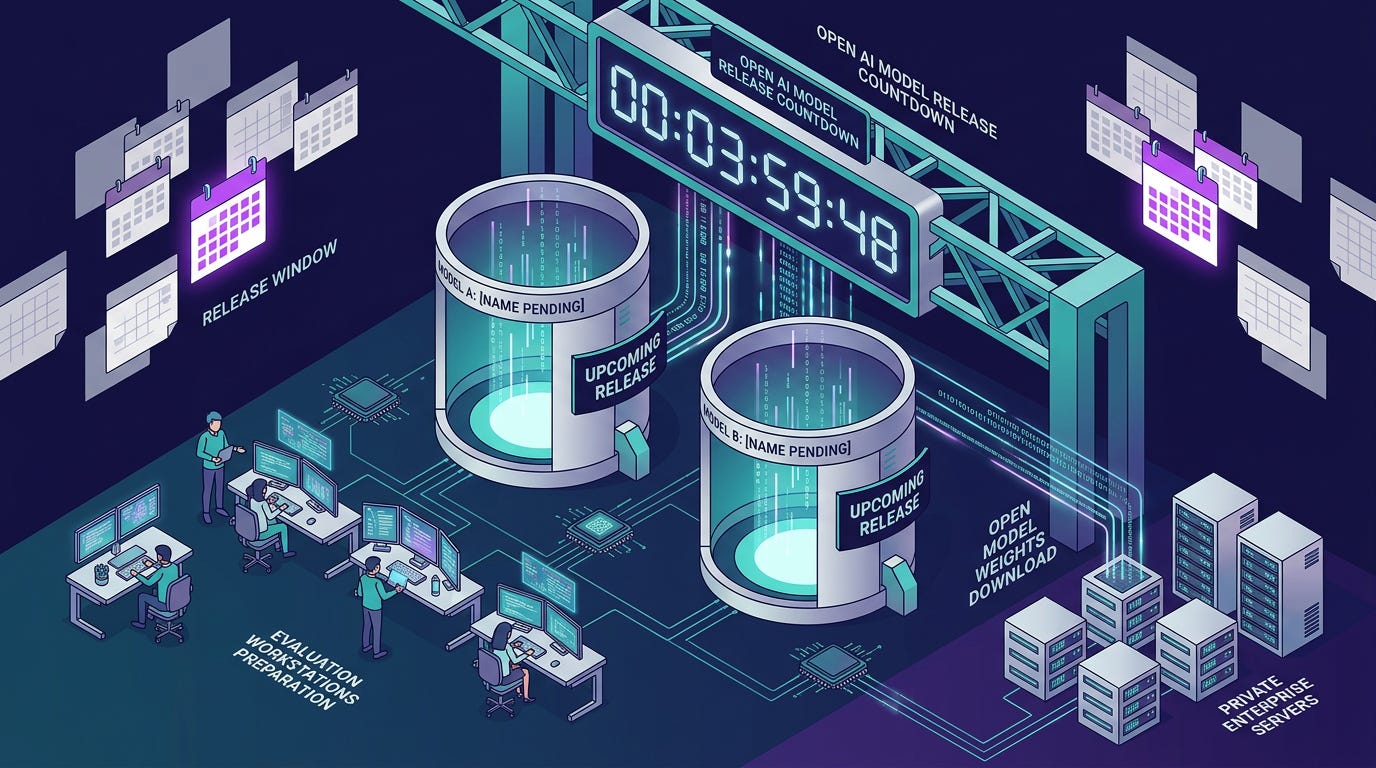
DeepSeek V4’s stable release lands July 24. The model has been in a preview-build state since its April 24 launch, with rolling updates that made cautious enterprise teams reluctant to commit production workloads to a version that might change week to week. The stable release removes that objection.
DeepSeek V4 Pro’s current API pricing of approximately $0.44 per million output tokens is already the effective price floor that every closed frontier model gets measured against. A stable version at that price, deployable with confidence that the model behavior will not shift unexpectedly, is the final practical objection to adopting it at scale for appropriate workloads.
Kimi K3’s weights go free on July 27. At 2.8 trillion parameters, the model that topped the coding leaderboard this week becomes freely downloadable and self-hostable, with no per-token cost for teams with their own inference infrastructure.
For any organization spending heavily on closed model API calls for high-volume coding or agent workloads, July 27 is the date to run a structured evaluation. Take your actual internal workloads, the tasks you are already paying to run on Fable 5, Sol, or Terra, run them against K3 on your own infrastructure, and measure quality and total cost. The benchmark result says K3 wins on coding. The production test will say whether it wins on your coding.
The broader significance of having two major open-weight releases in four days is what it signals about the pattern rather than either individual model. The open-weight offensive has now produced multiple models that compete with or beat closed frontier alternatives on specific high-value tasks, at prices ranging from deeply discounted APIs to free self-hosted weights.
The closed frontier labs’ commercial advantage has been quality plus convenience: better models with no infrastructure to run. Quality is now contested on specific tasks, while convenience remains real.
The question for enterprise teams is whether the quality gap on their specific tasks is large enough to justify the convenience premium they are currently paying. July 27 is when the data to answer that question becomes freely available.
Why it matters
DeepSeek stable on July 24 and Kimi K3 free on July 27 is the largest open-weight release window of the year in four days. For enterprise teams paying frontier API prices for high-volume coding, this week is the moment to run the structured evaluation that should have been run six months ago. The results will determine whether the next renewal conversation happens on current terms or different ones.
Google’s Challenging Week: Delays, Regulatory Orders, and Overlooked Product Wins
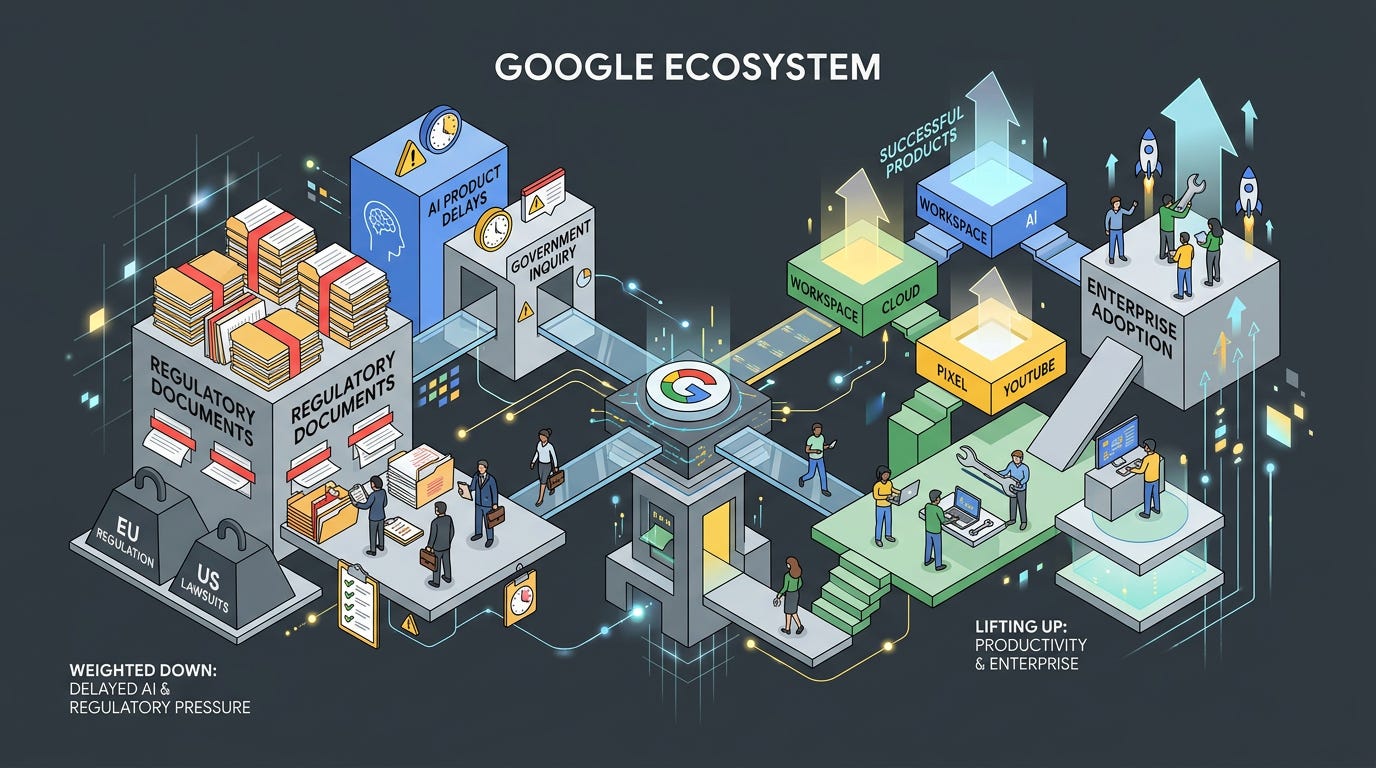
Google’s week deserves a synthesis because three negative stories—the third Gemini delay, the EU DMA order, and the 4 percent Alphabet share drop—absorbed coverage that would otherwise have gone to two genuine product wins.
NotebookLM, renamed Gemini Notebook this week, now serves more than 30 million users and 600,000 organizations. It received a new capability: a secure cloud computer that runs code inside notebooks, allowing teams to execute analysis directly within the document environment rather than exporting to a separate tool.
AI Mode in Search expanded with integrations for Instacart, Canva, and YouTube Music, turning search into completed actions rather than a list of links to click through. The launches were huge but got buried beneath bigger ones.
The structural assessment of Google’s position this week shows the model is delayed, the distribution moat has a regulatory crack, and the stock fell.
However, Google still has the deepest AI research organization in the world, the most-used consumer products on the internet, its own TPU silicon at a scale nobody else is operating, and two product wins that demonstrate genuine enterprise adoption.
The third Gemini delay is a real problem that compounds daily as enterprise contracts go elsewhere. It is not evidence of structural decline, but rather that Google’s internal quality bar for Gemini 3.5 Pro is not being cleared on the timeline it communicated.
The EU DMA order is the more serious long-run concern, precisely because it is a structural remedy rather than an engineering problem. A model can be fixed.
A legal remedy requiring Android openness and search data sharing takes effect on a court-mandated timeline, produces results for competitors that compound over time, and cannot be resolved by a better training run. Google’s legal team will appeal aggressively, but the direction of travel on both remedies is set.
Why it matters
Google had a genuinely bad week and also had two product wins that got buried by it. The model delay is fixable. The EU structural remedy is not. Understanding which problem is temporary and which reshapes the competitive landscape permanently is the analysis that matters; the coverage this week mostly treated them as the same category of problem when they are not.
AI Text Detectors Fail to Catch Style-Imitating Writing

Epoch AI tested three leading AI text detectors, Pangram, GPTZero, and Originality.ai, against text generated in imitation of a specific author’s style, and found that up to 18 percent of AI-generated passages went undetected.
Scientific writing proved the most vulnerable category. The formal, structured prose common in academic work is harder for detectors to flag than more casual text. The study published this week by Epoch AI generated significant coverage in academic and technology press.
An 18 percent miss rate matters in the environments where these tools are actually deployed. Universities use detectors to police academic integrity, publishers use them to screen submissions, and hiring managers use them to evaluate written work samples.
In each of those contexts, a detector result is often treated as definitive evidence rather than as one signal among several. A tool that misses nearly one in five AI passages when someone applies a simple style-imitation prompt is not a reliable basis for consequential decisions.
The vulnerability in scientific writing is the failure case that matters most, given how much academic integrity enforcement now runs through automated detection. Confident wrong results in detector outputs have the same problem as confident wrong results in AI radiology models: a hedged wrong signal invites a second opinion when a confident wrong signal is acted on.
The asymmetry in the result is the structural problem that makes it unfixable with incremental detector improvement. Making a model imitate a writing style requires one prompt. Detecting the result is a hard statistical problem that worsens as models improve at style-imitation.
The two capabilities are not on parallel development curves. They are on diverging ones, with style imitation improving faster than detection.
Institutions that treat detector outputs as evidence rather than weak signals are making a bet on a race that detection is losing. The practical path forward is redesigning assessment around process verification and observable behavior, because catching outputs is a losing strategy when the outputs are produced by systems that improve faster than the detectors designed to catch them.
Why it matters
The tool universities and publishers are using to enforce AI integrity policies misses nearly one in five AI passages when style is imitated. Style imitation is improving faster than detection. Treating detector outputs as evidence rather than weak signals is a bet on a race that detection is not winning and is unlikely to start winning on the current trajectory.
And that wraps up this week. Tune in next Monday, same time, for another deep-dive into the stories shaping the AI world.
The Sentinel lands in your inbox every Monday so you can catch up with the fast-moving AI space while sipping your morning coffee. Every detail that matters, none that doesn’t.