

Another Monday, another post to keep you up to speed with the AI world.
Google I/O delivered the biggest AI conference event in years. Three humanoid robots sorted 88,000 packages without stopping while 3 million people watched live. Microsoft’s infrastructure spend crossed $190B. And OpenAI’s custom chip entered production at Samsung.
Here’s everything you need to know before Monday gets the best of you.
Google I/O Wasn’t A Developer Conference. It Was A Declaration Of War.
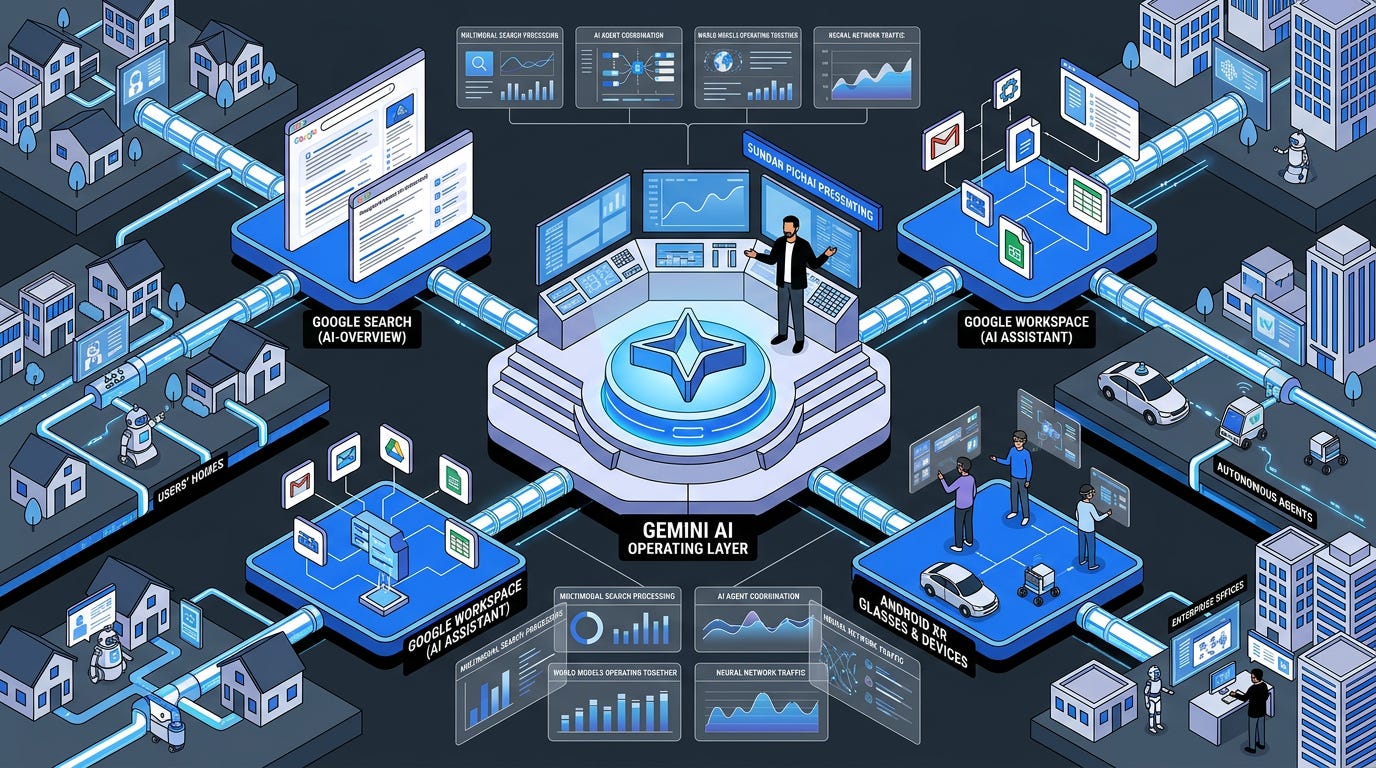
Over two days in Mountain View on May 19 and 20, Google made more AI announcements than at any event any company has held in the past two years.
CEO Sundar Pichai’s message was direct: AI should not be something you visit. It should be the infrastructure you live inside.
Google backed that with the biggest Search redesign in 27 years, two new flagship Gemini models, a 24/7 personal AI agent, a $100/month AI Ultra tier, Samsung XR smart glasses, and a live demo of an AI building an entire operating system from scratch on stage.
The models. Gemini 3.5 Flash is the new flagship.
Google claims it is four times faster than rival frontier models while matching or exceeding their quality across coding, reasoning, and multimodal tasks. Early developer testing has supported the speed claims.
Gemini Omni Flash is a world model trained on continuous streams of video, audio, and text at once, giving it persistent contextual awareness that single-modality models can’t match.
The pricing move. This is what changes competitive dynamics most directly.
AI Ultra at $100/month gives subscribers access to every Gemini model, Gemini Spark, 20TB of cloud storage, and Gemini in Workspace, with five times higher usage limits than the Pro plan.
ChatGPT Pro costs $200. Claude Max starts at $100. Google has cut the comparable price in half at launch.
That is a market share bet, not a margin bet. Google has the runway to sustain a loss long enough to reshape what AI subscription pricing looks like.
Why it matters
Google launched more consequential AI products in two days than most companies launch in a year, and undercut OpenAI and Anthropic on price at the same time. Willingness to lose money for market share is a different competitive threat than a better model.
Gemini Spark Runs While You Sleep.
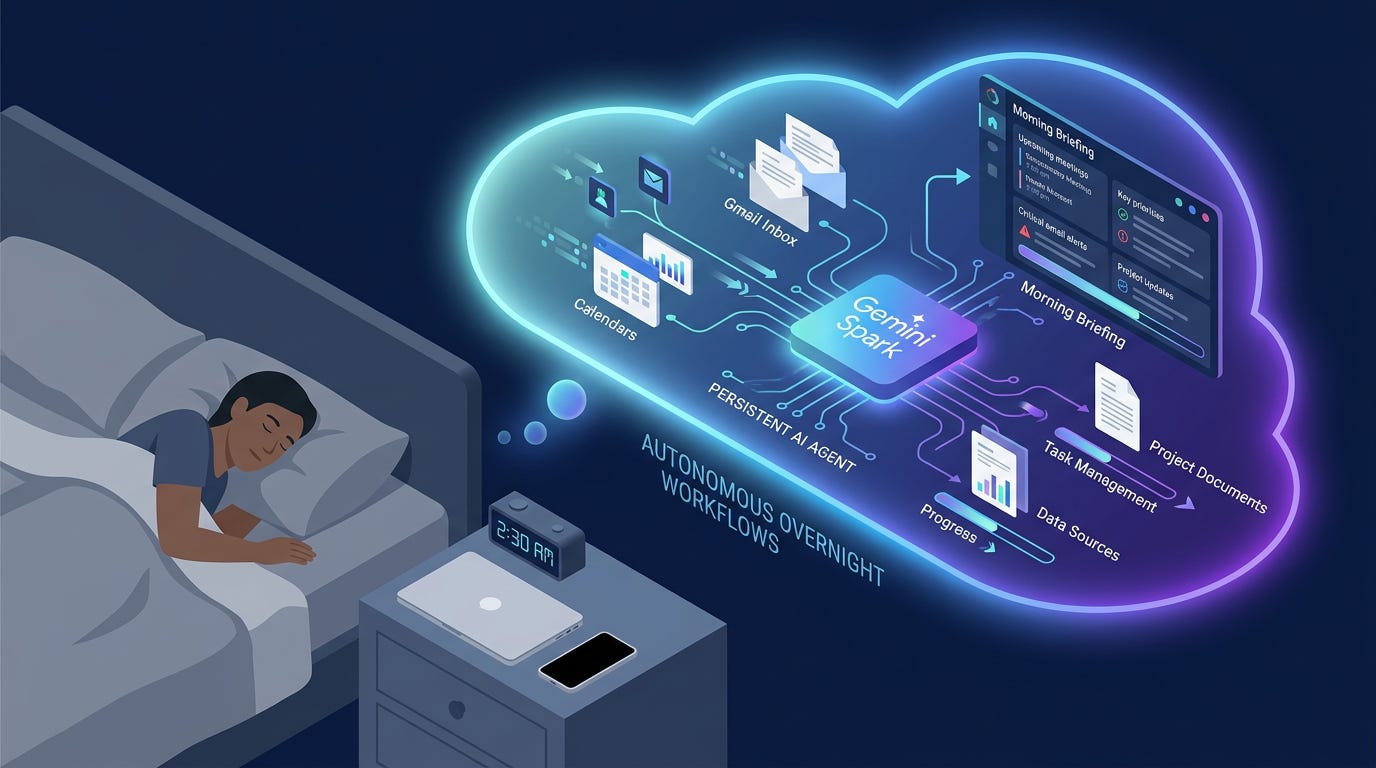
Gemini Spark is Google’s “24/7 personal agent for work, school, and daily life,” and it’s the I/O product that deserves its own story.
Every other AI assistant operates on a request-response model. You open the app, send a message, get an answer, and close the app.
Spark breaks that completely. It runs continuously on Google’s cloud, so it keeps working after your phone screen goes dark and your laptop lid is shut.
It has access to your apps, calendar, email, and documents, and takes actions on your behalf without being asked.
A “Daily Brief” feature scans your calendar and inbox overnight and delivers a prioritised plan every morning before you’ve opened anything yourself.
The architecture. Running an agent continuously in the cloud is a different engineering problem from running inference on demand.
Google has built session persistence, context retention across days and weeks, and Workspace integration at a depth that lets Spark act rather than just advise.
The unknowns. Spark is rolling out to AI Ultra subscribers over the next few weeks.
The real questions can only be answered in production: how it handles conflicting priorities, what it does when an autonomous action turns out wrong, and how much retained context proves useful versus noise.
Why it matters
Every AI assistant before Spark waited for you. Spark doesn’t. A persistent cloud agent that operates continuously and takes actions without prompting is a different product category. Whether the reality matches the demo will decide whether this week marks a real shift or an impressive announcement.
Three Humanoid Robots Ran For 40 Hours Straight. 3 Million People Watched.
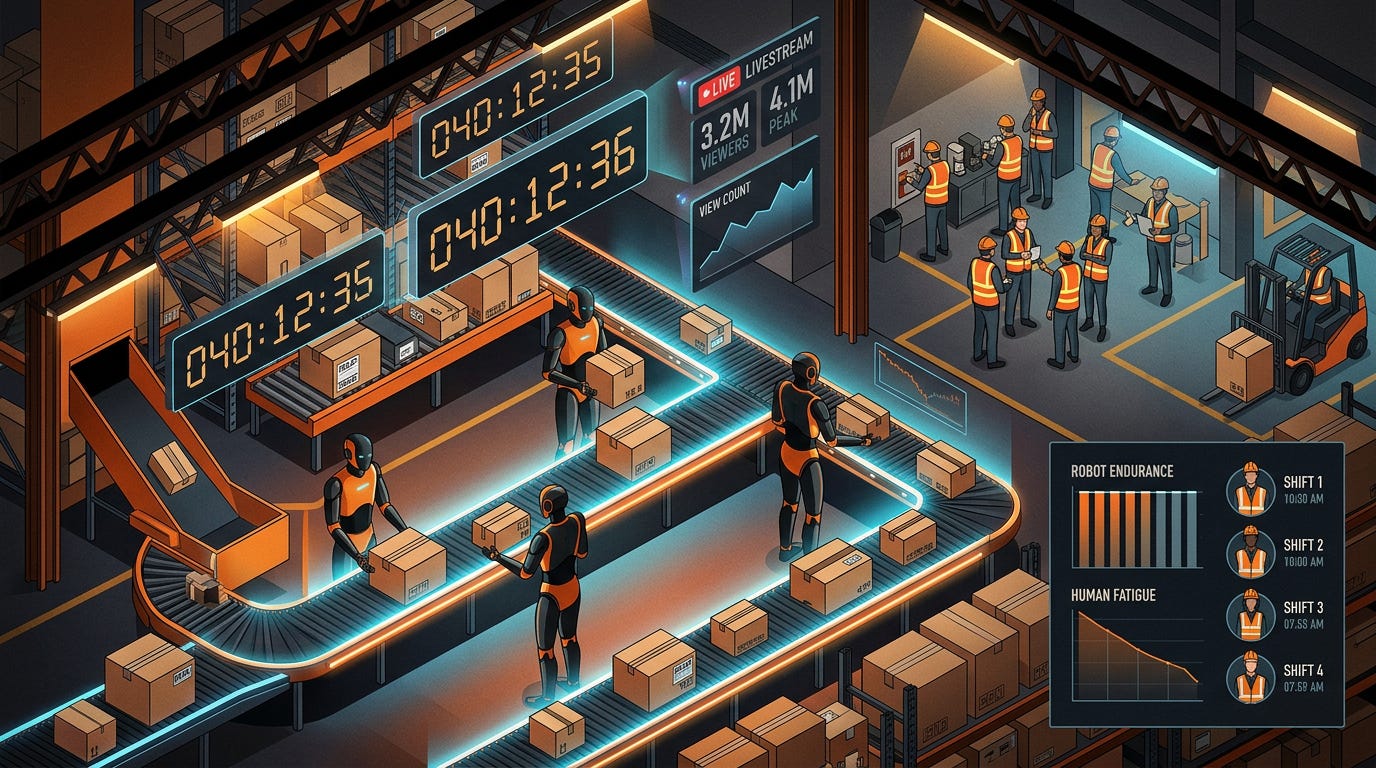
Figure AI planned an eight-hour demo. Bob, Frank, and Gary kept going for nearly 40.
The company’s Helix-02-powered humanoid robots began a livestreamed package-sorting run at their San Jose warehouse on May 13.
By the time the run passed 24 hours, 3 million people were watching on X, naming the robots and posting updates like a reality show. A fourth robot, Rose, joined mid-run.
Final numbers: four robots sorted 88,000 packages in 72 hours with zero reported failures. The pace was roughly one package every three seconds, matching human warehouse worker averages.
The technical claims. They hold up with caveats.
The robots detect barcodes using onboard cameras, pick packages, and place them barcode-face-down onto a conveyor belt. Everything runs through Helix-02 onboard, with no teleoperation.
Observers noted visible errors: packages placed barcode-up, one knocked off a belt.
CEO Brett Adcock said it directly: “F.03 is now around human parity.” Not better. Parity.
The honest data point. A human vs. robot test during the stream gave the most useful number of the week.
Over an eight-hour shift, the F.03 robot sorted 12,732 packages at 2.83 seconds per item. The human, a Figure employee named Aime, sorted 12,924 packages at 2.79 seconds.
The human won by 192 packages.
The real milestone isn’t speed. It’s that robots can sustain the pace for 40 hours without fatigue, breaks, or shift changes.
For 24-hour operations with rotating human shifts, that endurance changes the economic calculation even without a speed advantage.
Why it matters
A humanoid robot matching human speed at a repetitive logistics task, then running it for 40 hours without stopping, is a production viability data point. Warehousing and logistics are watching closely.
Anthropic’s $30 Billion Round Just Closed. It’s Now The Most Valuable Private Company In History.
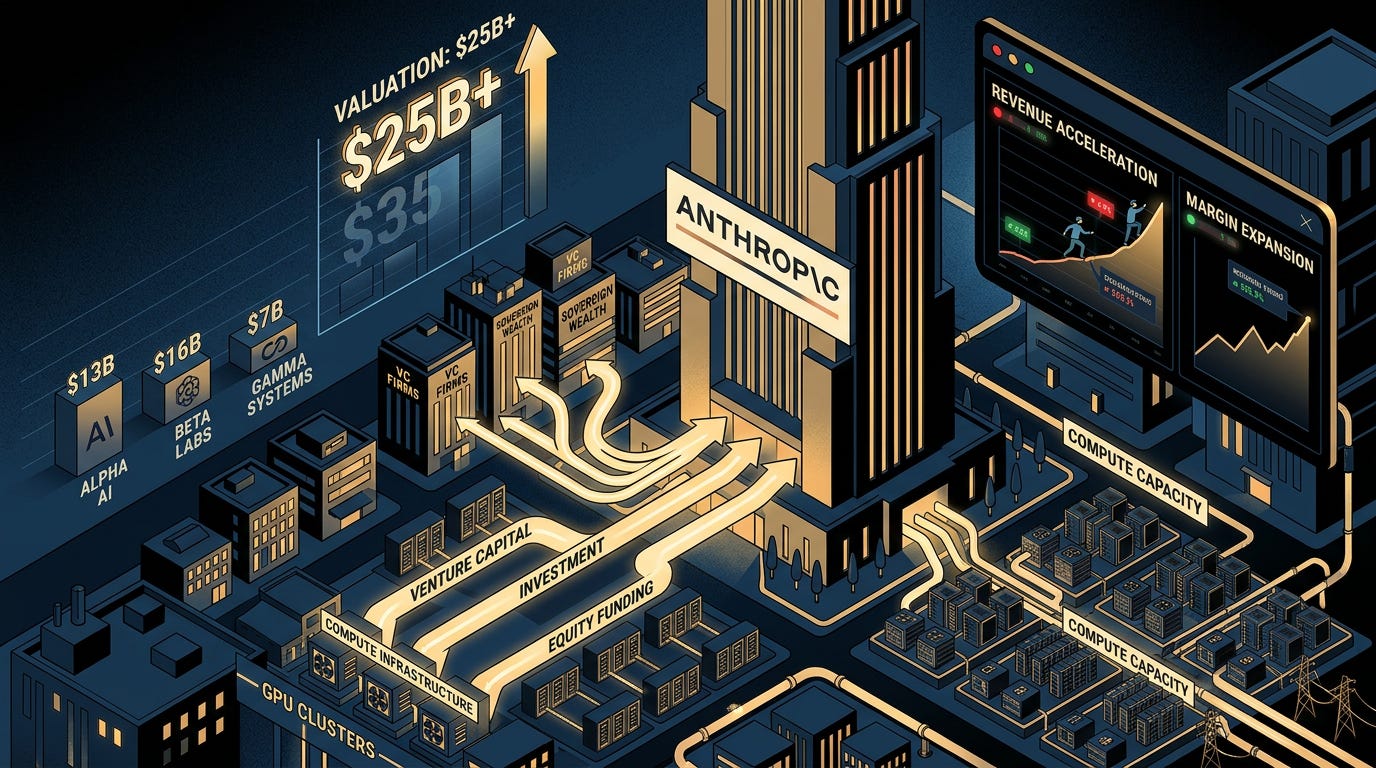
Anthropic’s $30 billion funding round closed this week at a pre-money valuation exceeding $900 billion, passing OpenAI’s $852 billion mark from March.
The round was led by Greenoaks, with Sequoia, Altimeter, and Dragoneer each investing $2 billion or more.
CFO Krishna Rao began gauging demand in late April, and the round assembled and closed in under five weeks.
Capital will mainly prepay for compute ahead of a planned IPO, which Bloomberg reports could arrive as early as October 2026.
The revenue trajectory. At the end of 2025, Anthropic’s annualised revenue was approximately $9 billion. By April 2026, it had passed $30 billion. The company projects $45 billion shortly.
Claude Code alone generates $2.5 billion annualised. Eight of the Fortune 10 are active clients. Over 1,000 enterprise accounts exceed $1 million in annual spend.
Gross margin moved from 38 percent a year ago to over 70 percent now.
That answers the standard objection to AI valuations: at 70 percent gross margin, Anthropic is a software business, not an infrastructure business.
Why it matters
Anthropic went from $380 billion to $900 billion in three months on revenue that grew 80x in 18 months and margins that crossed 70 percent. An October IPO at these levels would be among the most significant tech listings since the dot-com era. The company, founded as a safety-focused alternative to OpenAI, is now worth more than OpenAI.
Google Showed Off Its AI Glasses. Samsung Is Building Them. They Ship In The Autumn.
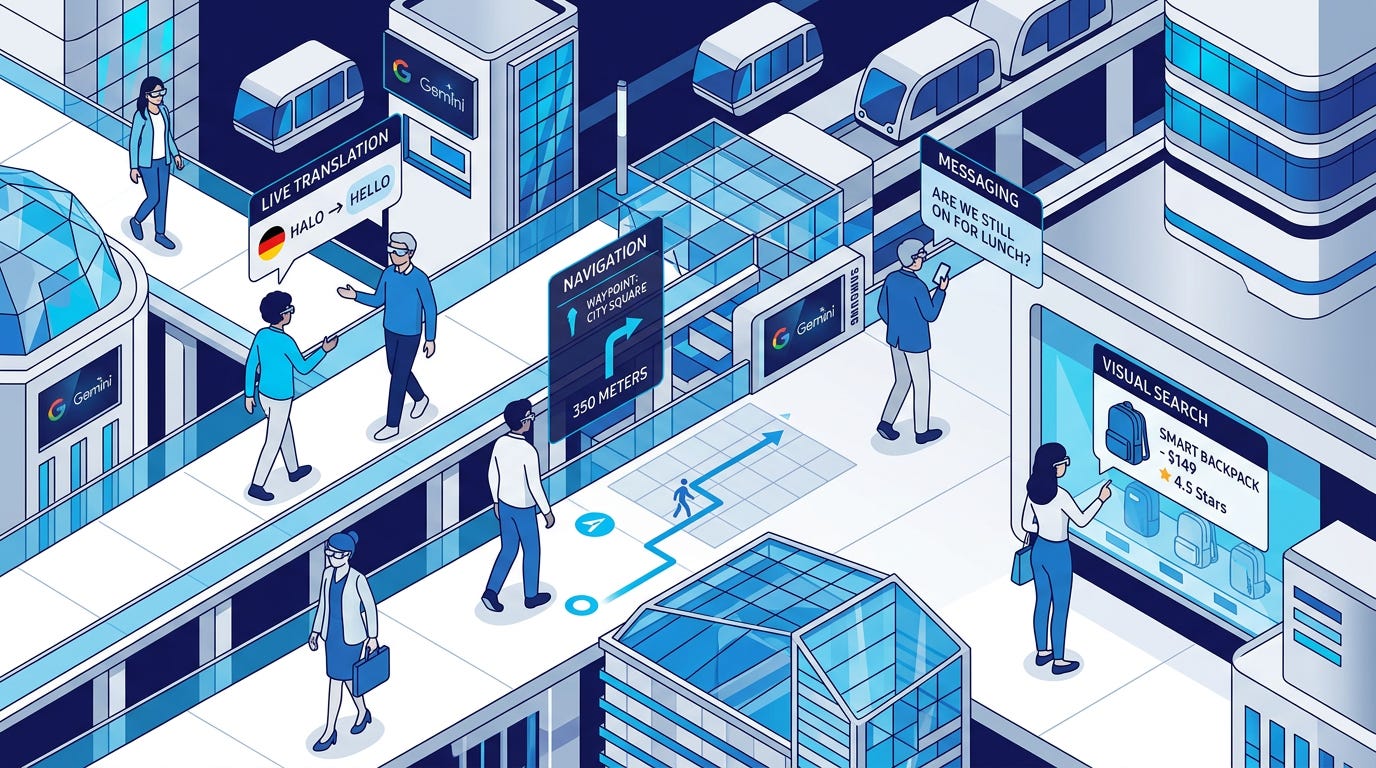
The final segment of Google’s I/O keynote was reserved for hardware.
Google and Samsung teased Android XR smart glasses with two variants: an audio-only model that functions as a continuous Gemini speaker, and a display-lens model that overlays information in the wearer’s field of view.
Both are built around continuous Gemini conversations rather than discrete app interactions.
The Samsung XR glasses ship in autumn 2026. Price unconfirmed.
The context. Google Glass launched in 2013 and failed because it looked strange, felt expensive, and had no compelling daily use case.
The Android XR glasses arrive in a different environment. Modern AI can make ambient, always-on assistance genuinely useful in ways 2013 technology could not.
Cameras and mics in the frame feed real-time context to Gemini. Live translation, contextual navigation, and hands-free information retrieval are obvious early use cases.
The design problem that killed Glass isn’t fully solved. Neither variant is yet consumer-ready in appearance.
But Samsung building the hardware and Google providing the AI is the partnership structure that gives this its best chance.
Why it matters
Wearable AI glasses have failed every time because the AI wasn’t good enough to justify wearing a computer on your face. The AI is now good enough. The question this autumn is whether the hardware is comfortable enough and the use cases obvious enough for consumers.
OpenAI’s Custom Chip Just Entered Production. Samsung Is Making It. NVIDIA Is Watching.
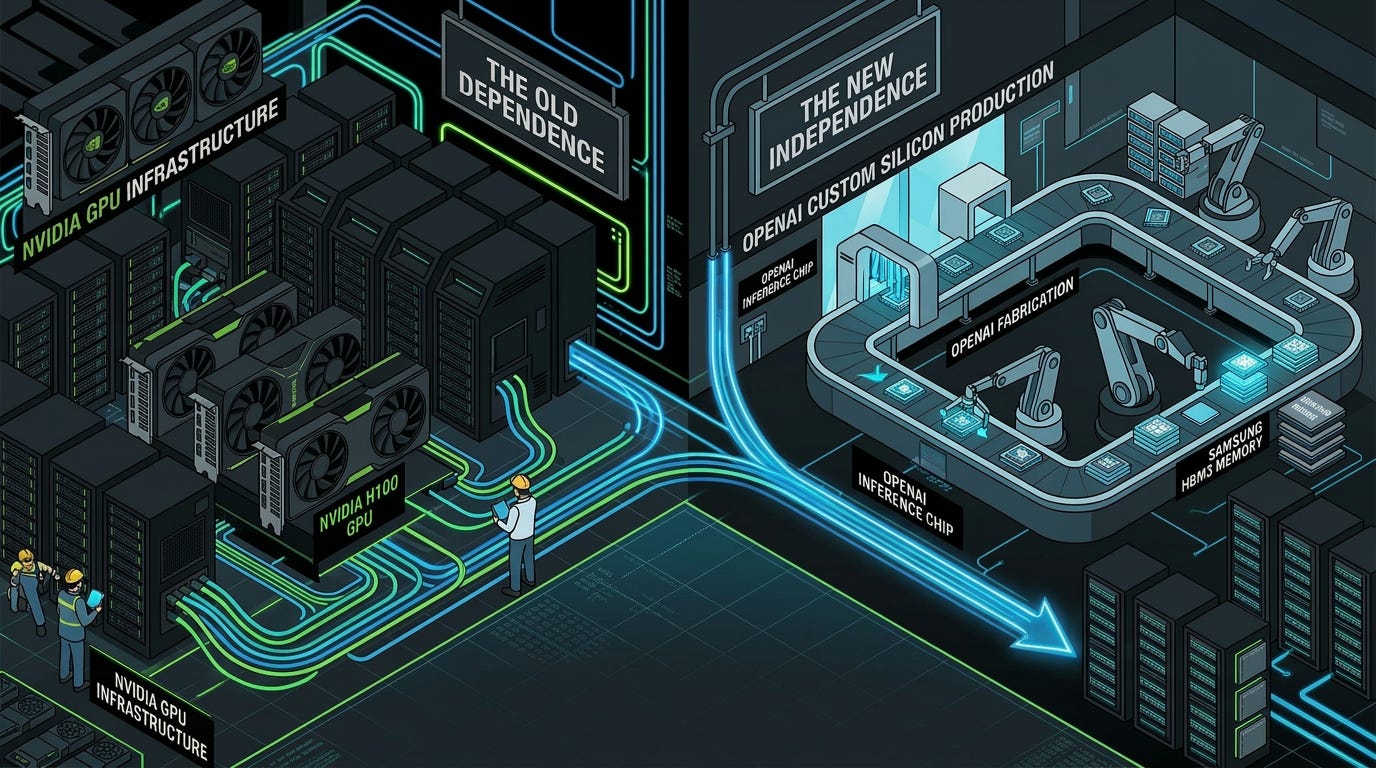
OpenAI’s custom AI chip program, codenamed Project Titan, entered production at Samsung this week.
The chip is co-developed with Broadcom, manufactured on TSMC’s 3nm process, and uses Samsung’s HBM4 memory under an exclusive supply agreement.
The first-generation chip is an inference accelerator, designed to run AI models at scale rather than train new ones.
The milestone matters because OpenAI has relied on NVIDIA for almost all its compute since its founding. Every ChatGPT inference call, every API response, runs on NVIDIA hardware. Project Titan begins changing that.
The economics. OpenAI’s inference costs for reasoning models are one of the largest constraints on its business model.
Reasoning models use substantially more compute per query than standard language models.
A custom inference chip optimised for OpenAI’s architectures can, in principle, cut those costs by 40 to 50 percent versus general-purpose NVIDIA GPUs.
At OpenAI’s scale, that’s a structural change in unit economics.
The pattern. Google has TPUs. Amazon has Trainium and Inferentia. Meta has MTIA. Microsoft is partnering on custom silicon. OpenAI completes the set.
NVIDIA’s training dominance isn’t under near-term threat, but inference, where production compute volume is consumed, is becoming a custom silicon market.
Why it matters
Every major AI company now has a path to inference independence from NVIDIA. That puts a ceiling on how much of the inference market NVIDIA can hold long-term.
Microsoft Is Spending $190 Billion On AI Infrastructure This Year. It Still Isn’t Enough.
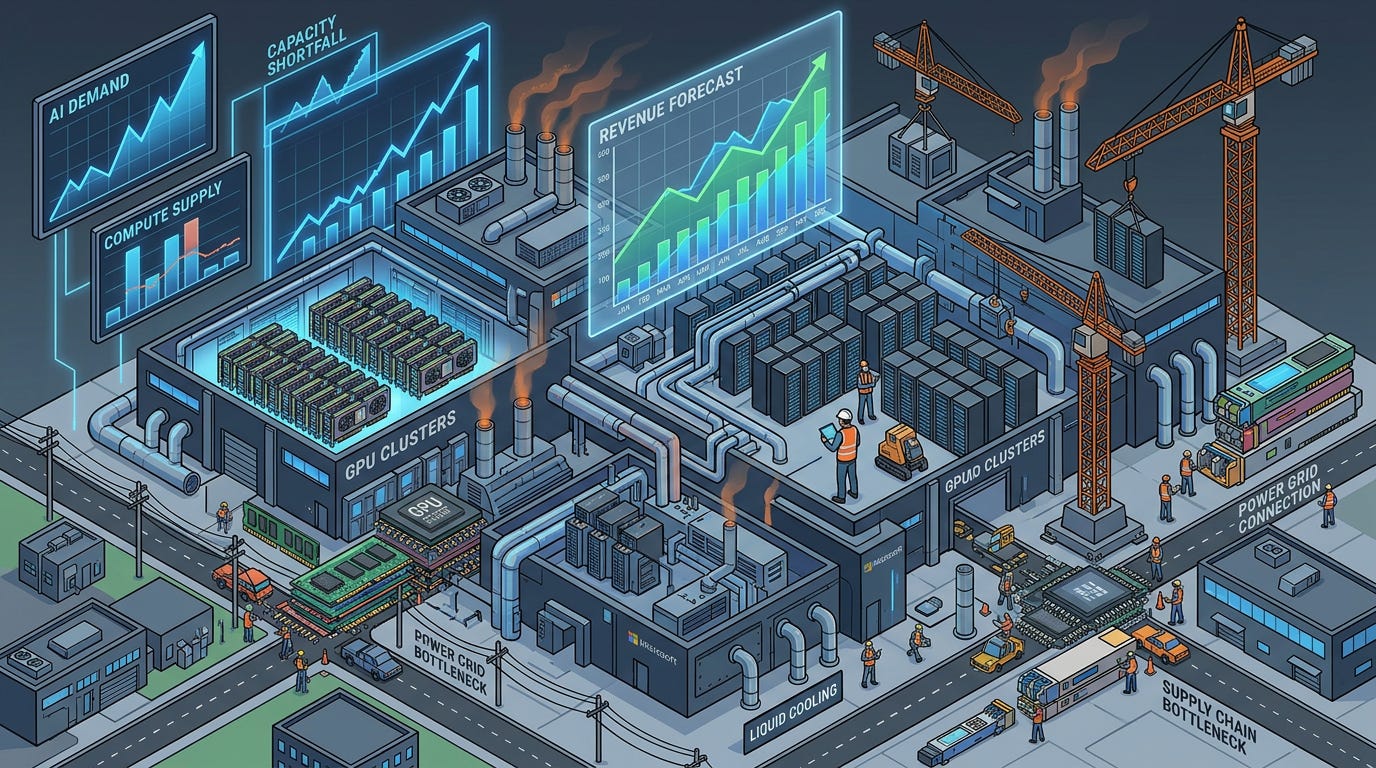
Microsoft CFO Amy Hood disclosed this week that 2026 capex has been revised upward to $190 billion, against an average analyst forecast of $152 billion.
The $38 billion revision is driven mainly by surging prices for memory chips, storage, and GPU substrates, which Hood said accounted for $25 billion alone.
Despite spending at a pace unimaginable three years ago, Hood told investors Microsoft expects to remain capacity-constrained on GPUs, CPUs, and storage through at least the end of 2026.
The company currently has more contracted AI revenue than it can physically serve.
The revenue picture. Microsoft’s commercial remaining performance obligations have surged to roughly $625 billion. That’s contracted future revenue, not speculative pipeline.
Microsoft’s cloud and AI services are sold out. The constraint on revenue recognition isn’t demand. It’s physical infrastructure.
Every gigawatt of power Microsoft brings online converts directly into revenue it cannot currently book.
AI data centers require 80 to 140 kilowatts per rack versus 5 to 15 for traditional servers, meaning power, cooling, and construction costs are all significantly higher per unit of compute than historical norms.
Why it matters
Microsoft is spending $190 billion this year and still can’t serve all its contracted demand. That isn’t a bubble. It’s supply constrained by physical reality. The buildout is real, the demand is real, and the constraint is how fast the world can manufacture the components.
Google Redesigned Search For The First Time In 27 Years.
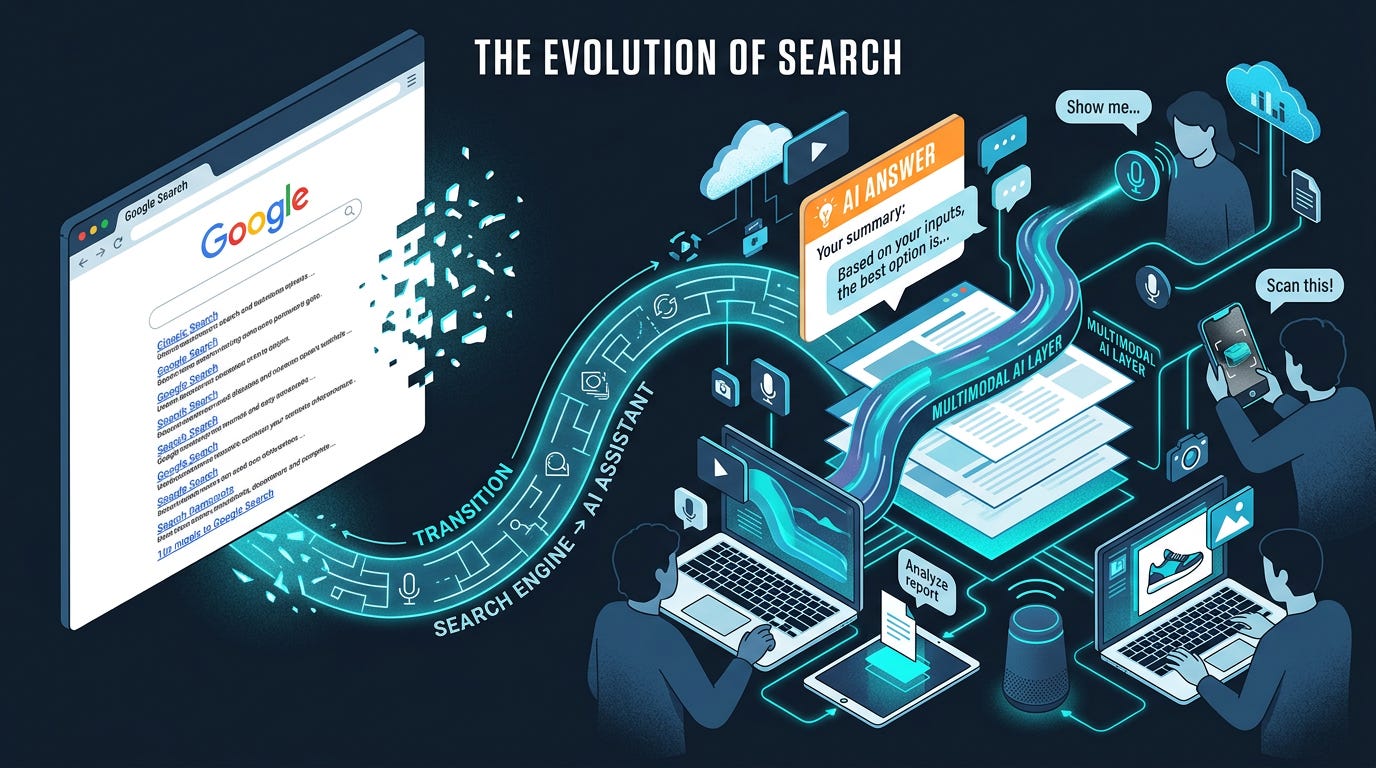
Google Search has operated on essentially the same interface paradigm since 1998: a text box, a button, a list of results.
At I/O this week, Google announced the end of that paradigm.
The new Search accepts text, images, files, videos, and open Chrome tabs as simultaneous inputs.
A user can share a screenshot, a PDF, a video clip, and a question all at once, and search reasons across them together rather than treating each as a separate query.
AI Overviews are now the default response format for complex queries, with traditional blue links appearing as supporting detail beneath.
Search Live. Announced alongside the redesign, it uses the device’s camera and microphone to answer questions about what the user is looking at or hearing in real time.
Point a camera at the equipment with an error message, and Search can explain it. Hold it up to a restaurant menu, and Search can recommend dishes based on dietary preferences.
The competitive significance. Google Search has roughly 90 percent of the global market share and processes about 8.5 billion queries per day.
If those queries shift from link-lists to AI answers, the economics of web publishing, advertising, and SEO all change at once.
Making AI Overviews the default is Google deciding the transition is happening whether it manages it or not, and that the risk of being displaced is greater than the risk of disrupting its own ad business.
Why it matters
Google just changed how Search works for the first time in nearly three decades. The text box is no longer the interface. AI answers aren’t a feature within Search. They are Search.
And that wraps up this week. Tune in next Monday, same time, for another deep-dive into the stories shaping the AI world.
The Sentinel lands in your inbox every Monday so you can catch up with the fast-moving AI space while sipping your morning coffee. Every detail that matters, none that doesn’t.